

On this page
- Why Long Hair Can Look Flatter Than You’d Like
- Does the Exact Length Matter, Not Just the Cut?
- Layering Techniques That Add Shape Without Losing Length
- Bangs and Fringe That Create the Illusion of Volume
- Blunt Ends vs. Textured Ends
- Color Techniques That Add the Illusion of Depth
- Styling Techniques That Build Real Volume
- Partings and Placement That Change the Whole Look
- Long Hairstyles Worth Trying
- What Tends to Work Against You
- Accessories That Add Instant Volume
- A Simple Weekly Routine to Keep Volume Longer
- Choosing What Fits Your Routine
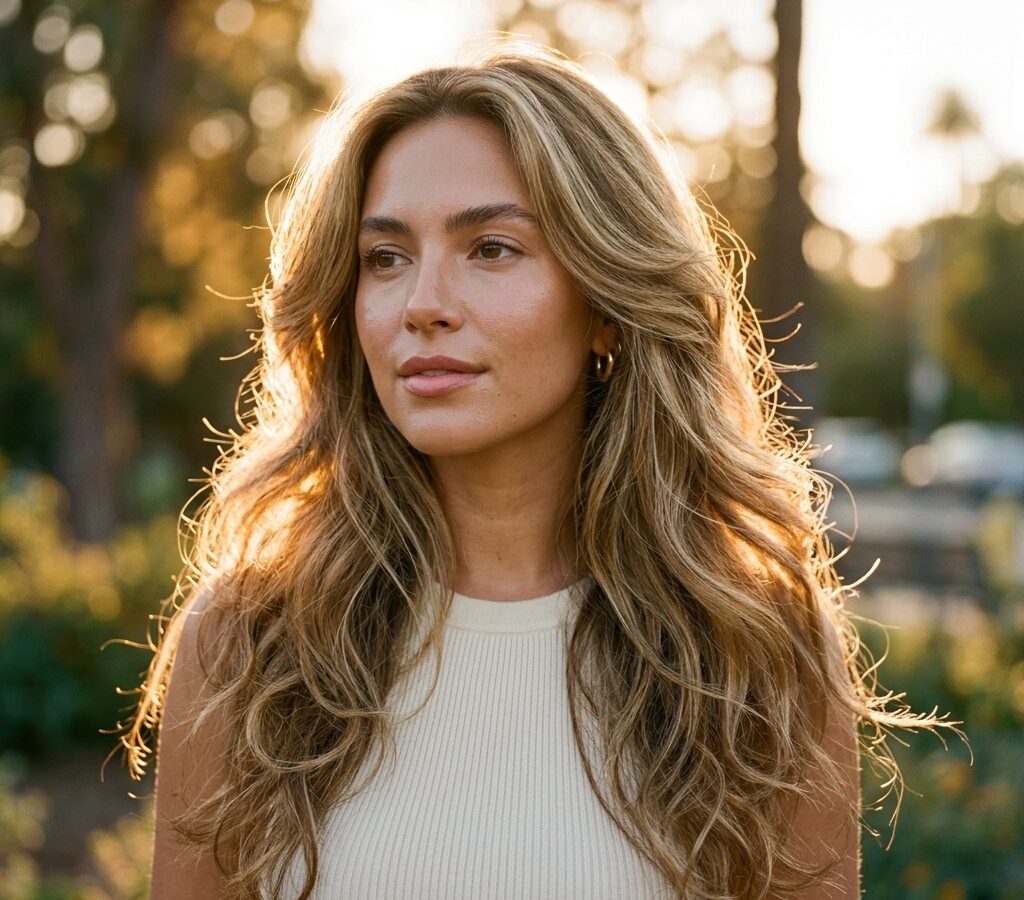
Long hair and thin hair do not always get along. The weight of extra length tends to pull strands flat, especially near the roots, and by the afternoon a style that looked full in the morning can end up limp against the scalp. This does not mean long hair is off the table if your strands are fine or sparse. It means the cut, the parting, and a few styling habits matter more than usual.
This guide walks through the choices that actually change how thin hair reads to the eye when it is left long, from layering patterns to the small details in blow-drying that stylists rely on again and again.
Why Long Hair Can Look Flatter Than You’d Like
Two different things get lumped together under “thin hair,” and it helps to tell them apart before picking a style.
- Fine hair refers to the width of each individual strand. Fine strands are thinner in diameter, so they bend and lie flat more easily.
- Thin hair usually refers to hair density, meaning fewer strands per square inch of scalp.
Many people deal with both at once, and long length makes either one more noticeable. Gravity pulls weight downward along the shaft, smoothing out any natural lift at the crown. The longer the hair, the more pronounced this pull becomes, which is why a chin-length style can look bouncy while the same hair grown past the shoulders can look stringy by the end of the day.

Does the Exact Length Matter, Not Just the Cut?
Two people can both have “long hair” and get very different results from the same layering technique, simply because of where the length ends.
Hair that falls just past the shoulders sits at a length where the weight is still manageable. There is enough length for movement, but not so much that gravity overwhelms every layer underneath it. This is often considered a middle ground for fine hair, long enough to feel like a real change from a short cut, short enough that the ends do not drag the whole style down.
Hair that reaches the middle of the back or further carries a lot more weight at the ends, and that weight has to go somewhere. On thick hair this is rarely a problem. On thin hair, the extra inches usually mean the roots get pulled flatter than they would at a shorter length, even with a good haircut.
This does not mean waist-length hair is impossible for fine strands, but it usually needs more frequent layering maintenance and more deliberate styling to avoid looking stringy. Anyone debating between growing hair out further or keeping it around shoulder length might find that the shorter option requires noticeably less daily effort to look full.
Layering Techniques That Add Shape Without Losing Length
Layers are the single biggest factor in how full long, thin hair looks. Done well, they remove excess weight from the ends and let the hair move instead of hanging in one flat sheet.
Long Layers
Long layers are cut gradually throughout the length rather than all at one point, so the silhouette stays intact while the ends get lighter. This reduces the “one heavy curtain” effect that makes fine hair look thin, and it gives the mid-lengths somewhere to move when you turn your head or walk.
Ghost Layers
Ghost layers, sometimes called invisible layers, are shorter pieces cut underneath the visible top layer. From the outside the hair still looks like one solid length, but underneath there is lift and texture doing the work. This technique is popular with stylists specifically because it avoids the choppy, stair-step look that heavier layering can create on fine strands.
Face-Framing Layers
Shorter pieces cut around the cheekbones and jaw catch the light differently from the rest of the hair. Because they are shorter, they have less weight pulling on them, so they naturally sit with a bit of lift. This draws the eye toward the face and away from any flatness at the crown.
Bangs and Fringe That Create the Illusion of Volume
Bangs are not just a styling choice, they change how much hair is visible at eye level, which shifts the overall impression of density.
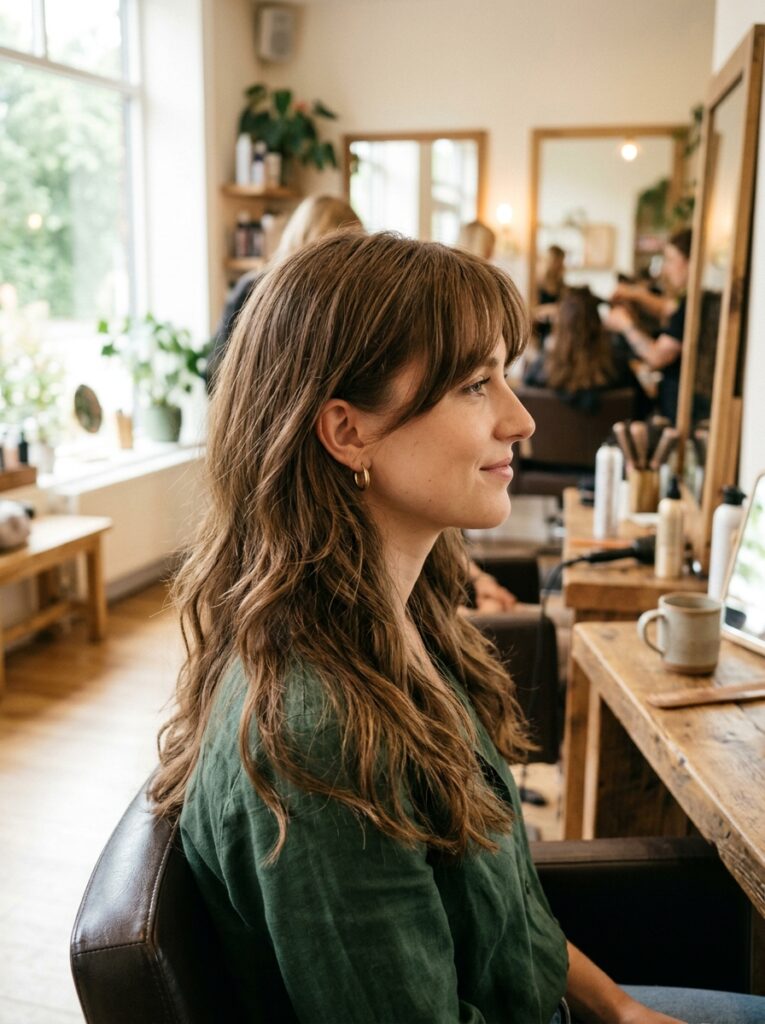
- Curtain bangs part naturally down the middle and frame both sides of the face. Because they are long enough to blend into the rest of the hair, they add fullness around the forehead and temples without requiring a full fringe commitment.
- Wispy fringe is cut with soft, uneven pieces rather than one blunt line. The irregular ends catch light in different directions, which reads as more texture even though the amount of hair has not changed.
- Side-swept fringe works well for anyone who wants extra coverage over a wider part line, since it can be brushed to sit over thinner sections near the hairline.
Any of these can be added to an existing long cut without a dramatic change, which makes fringe one of the lower-commitment ways to test whether more volume near the face suits you.
Blunt Ends vs. Textured Ends
There is an ongoing debate among stylists about whether blunt ends or textured ends make thin hair look thicker, and the honest answer is that both work, just for different reasons.
Blunt ends are cut straight across in one clean line. Because every strand ends at roughly the same point, the ends appear denser when viewed together, similar to how a stack of paper looks thicker when the edges are aligned. This is why a classic long bob or a one-length lob is often recommended for fine hair.
Textured ends are cut with a razor or point-cutting shears, creating slightly uneven edges. This softens the line and can hide the fact that the hair thins out toward the tips, though it does not create the same dense-looking edge that a blunt cut does.
A common compromise is to keep the ends mostly blunt while adding light texture only in the last inch or two, which preserves the illusion of thickness while still allowing some movement.
Color Techniques That Add the Illusion of Depth
Cut and styling are not the only tools available. Color placement changes how light bounces off hair, and light plus shadow is a big part of what reads as “volume” from a distance.
- Babylights are extremely fine highlights placed close to the natural color. Because there are so many thin strands of color woven through the hair, the overall effect is more dimension without a dramatic contrast, which can make thin sections look denser under normal lighting.
- Balayage uses a hand-painted technique that is usually lighter toward the ends and softer near the roots. This creates a gradient effect that draws the eye down the length of the hair, distracting from areas where density drops off.
- Low-lights work in the opposite direction, adding slightly darker pieces underneath the top layer. The darker sections sit like a shadow beneath the lighter surface hair, which visually pushes the top layer forward and makes it look thicker by comparison.
None of these techniques change the actual number of strands on the head, but the play between light and dark tones tricks the eye into perceiving more depth and texture than a single flat color would. For fine hair specifically, sticking closer to your natural base color with dimension woven through it usually looks more convincing than heavy, high-contrast color blocks, which can sometimes emphasize how the hair lies flat rather than disguising it.
Styling Techniques That Build Real Volume
Even the best haircut needs some help from styling to reach its full potential, particularly at the roots.
Root Lift While Blow-Drying
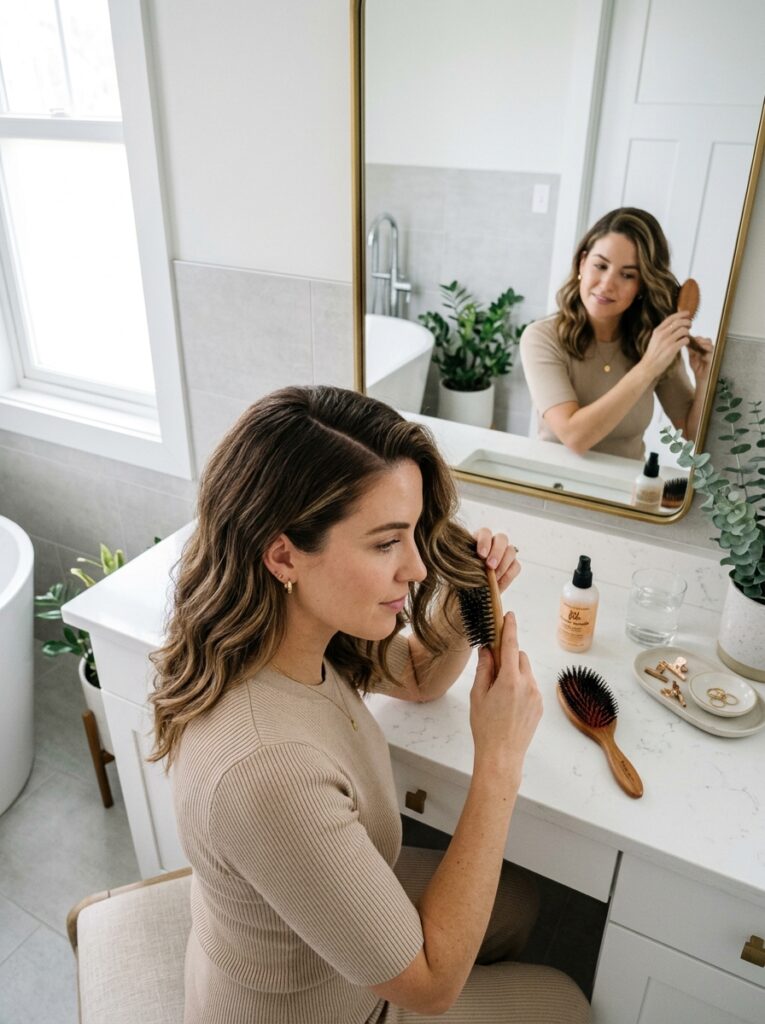
Bending forward and blow-drying the roots in the opposite direction of how they naturally fall lifts the hair away from the scalp before it has a chance to settle flat. A round brush used at the roots, moving from side to side rather than straight back, gives the base extra height that lasts through much of the day.
Rollers or a Curling Iron at the Crown
You do not need to curl the entire head to add fullness. Wrapping small sections at the crown and temples around a curling iron or hot rollers, then letting them cool before brushing out gently, adds lift exactly where flatness tends to show first.
Braids and Twists for Texture
A loose braid worn overnight or for a few hours and then taken out creates soft waves that break up smooth, flat strands. This works especially well on second-day hair, when a bit of natural texture already gives the braid something to hold onto.
Product Placement, Not Product Overload
Volumizing mousse or a lightweight texturizing spray applied at the roots, rather than throughout the length, avoids the weighed-down look that heavier products can cause on fine hair. Applying product only where lift is needed, and skipping the ends entirely, keeps the rest of the hair from going limp.
Partings and Placement That Change the Whole Look
Where the hair parts has a bigger effect on perceived volume than most people expect.
- A deep side part creates an angle that naturally lifts one side higher than the other, adding dimension that a straight center part does not.
- A zigzag part breaks up the scalp visibility along a single line, making the roots look denser from a distance.
- Switching your part occasionally prevents the same section of hair from being trained flat in one direction, which happens naturally over time with a part that never changes.
None of these require a haircut change, so they are worth experimenting with before booking a salon visit.
Long Hairstyles Worth Trying
Bringing the ideas above together, here are specific long looks that tend to work well on thin or fine hair:
- Long layered shag. Heavy layering throughout, paired with wispy bangs, creates texture from root to tip. This is one of the more forgiving cuts for fine hair because the layers are doing most of the volume work on their own, which means less daily styling is needed to keep the shape looking intentional.
- Soft, undone waves. Loose waves add width to the overall shape without the stiffness of a tight curl. A large-barrel curling iron used on alternating sections, then brushed out lightly with fingers rather than a comb, gives a more natural, fuller-looking wave pattern.
- Low, slightly loose ponytail. Pulling a few face-framing pieces loose and gently teasing the crown before tying it back keeps a ponytail from looking flat against the head. Wrapping a small section of hair around the base to hide the elastic also adds a bit of extra visual thickness right where the ponytail begins.
- Half-up style with a bump. Backcombing just the underside of the top section before securing it adds noticeable lift at the crown while keeping the rest of the length down. This style works well for anyone who wants some hair off their face without committing to a full updo.
- Braided crown. A loose braid wrapped around the head hides thinner areas near the part and adds structural volume that a plain style cannot. Pulling gently on the braid’s edges after securing it, to loosen and widen each section, makes the braid itself look fuller than a tightly woven one.
- Blowout with round-brush finish. A classic salon blowout, focused on lifting the roots and curling the ends under or out, remains one of the most reliable volume boosters for long hair. Sectioning the hair into smaller pieces while drying, rather than working with large chunks, gives each section more direct heat and a cleaner curl pattern once it cools.
What Tends to Work Against You
A few habits and choices consistently make thin, long hair look thinner rather than fuller.
- Keeping hair at one uniform length with no layering at all, which lets weight pull the whole style flat.
- Overloading the lengths with heavy oils, serums, or creams, which weighs strands down even when the intention is to add shine.
- Sleeping on hair without any protection, which can cause tangling and breakage that leaves ends looking sparse over time.
- Using the same center part every single day, which trains the hair to fall in one predictable, flat direction.
- Skipping regular trims, since split or damaged ends often look thinner and catch less light than healthy ones.
Accessories That Add Instant Volume
Sometimes the fastest fix has nothing to do with the haircut itself.
- Thin headbands or bump-it style inserts tucked at the crown before the rest of the hair is styled over them create height that stays put through the day, without any teasing or product required.
- Silk or satin scrunchies cause less friction than regular elastic bands, which means less flattening around the area where a ponytail or bun is secured.
- Clip-in extensions or volumizing wefts, added underneath the natural hair at the crown or nape, are a temporary option worth considering for special occasions when extra density is needed just for a few hours.
- Claw clips used loosely rather than pulled tight can hold a half-up style with visible lift at the crown, instead of flattening the roots the way a tight elastic often does.
These are not permanent solutions, but they are useful for days when a full styling routine is not realistic, or for events where extra fullness matters more than usual.
A Simple Weekly Routine to Keep Volume Longer
Building volume is not only about a single hairstyling session. A few consistent habits make a noticeable difference over a few weeks:
- Wash with a lightweight, volumizing formula and apply conditioner only from mid-length to ends.
- Dry roots upside down for the first few minutes to encourage natural lift before finishing with a round brush.
- Alternate your part every so often rather than sticking to the exact same line daily.
- Trim every eight to ten weeks to keep ends looking dense rather than wispy in an unintentional way.
- Give hair a break from heavy styling products at least once or twice a week so it does not build up residue.
According to general guidance from the American Academy of Dermatology, everyday habits like washing routine and product buildup play a real role in how healthy and full hair looks over time, which lines up with why consistency matters more than any single styling trick.
Choosing What Fits Your Routine
Not every style here needs to happen at once. Someone who blow-dries daily might get the most benefit from root-lifting technique and a well-placed part, while someone who prefers low-maintenance hair might see a bigger difference from a good layering cut that does most of the work on its own. The right combination usually comes down to how much time you want to spend styling versus how much you want the cut itself to carry the look.
If you are exploring more long hairstyle ideas, it helps to bring reference photos to a stylist consultation so they can see exactly which direction of layering or fringe you have in mind. And if length is not a strict requirement, browsing short hairstyle options alongside long ones can offer a useful comparison, since shorter cuts often demonstrate volume-building techniques in a more compact way. For anyone weighing a big event on the calendar, it is also worth looking at bridal hairstyle inspiration, since many updo and half-up techniques used for weddings rely on the same volume tricks described above.
Long hair and thin strands can work together with the right combination of cut, part, and a few minutes of extra styling attention. The goal is not to fight the natural texture, but to work with it in a way that keeps the length you want while giving the hair somewhere to move.


Ella is a fashion and beauty writer who shares inspiring ideas about hairstyles, nail designs, wedding outfits, and seasonal fashion trends. She loves discovering fresh styles and creating…
View Author Profile →

1 Comment