

On this page
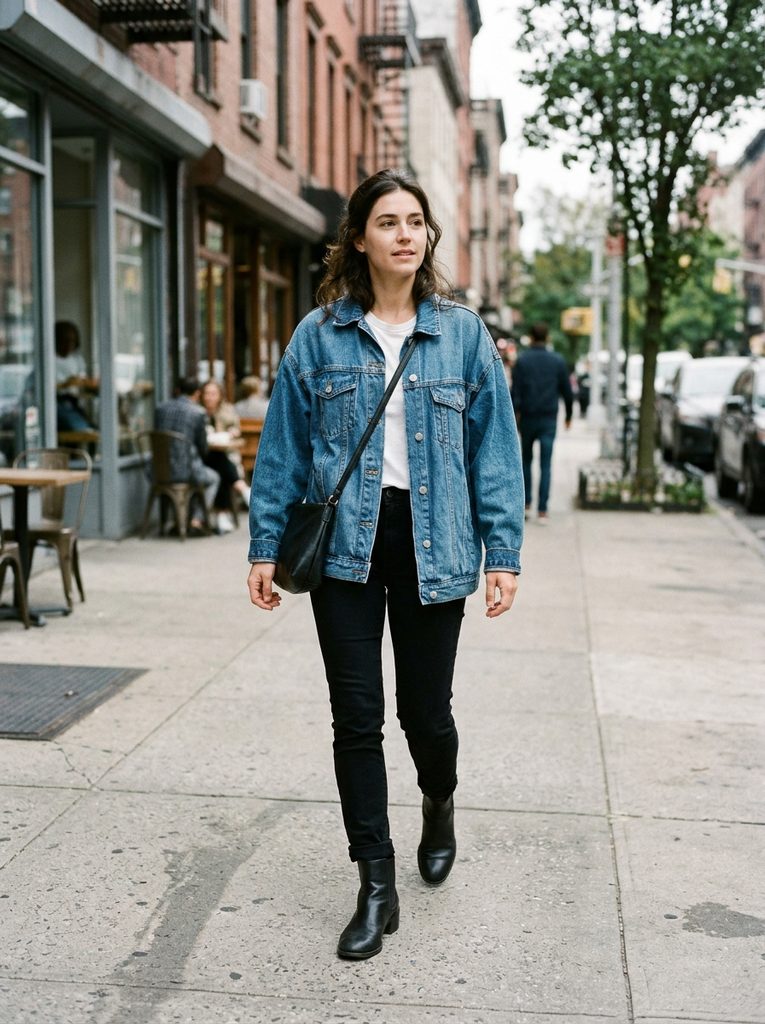
An oversized jacket is mostly extra fabric, and extra fabric has to go somewhere. Left alone, it settles around the shoulders, hangs off the hips, and swallows the hands. Handled well, the same volume looks relaxed and a little sharp, like the outfit was built around it.
The difference comes down to proportion. That word sounds technical, but the idea is plain: if one part of an outfit is big, another part needs to be defined. This guide breaks oversized jean jacket outfits into simple formulas, with fixes for sleeves, hems, and different heights.
Where the Extra Fabric Actually Sits
Before pairing anything, it helps to see where the volume lives. An oversized jean jacket usually has four loose zones.
- Shoulders. The seam drops past the natural shoulder line, sometimes by several inches.
- Body. The chest and torso are wide, so the jacket hangs away from the frame.
- Sleeves. They run long and wide, and often cover the knuckles.
- Hem. It sits at the hip or lower, and it can look boxy from the side.
Here is the part most people skip. You do not need to fight all four zones. Pick one area of the outfit to keep fitted, and let the jacket be loose everywhere else. A fitted waist, a narrow leg, or a visible wrist is often enough to show that the volume is on purpose.
Think of it as giving the eye one place to rest. When everything is loose, an outfit reads as shapeless. When one zone is clear, the whole look gains a frame.

Three Rules That Do Most of the Work
Rule One: Balance Big With Narrow
When the top has volume, the bottom usually looks best with less. Slim jeans, straight trousers, and fitted skirts all follow this. The jacket becomes the wide part of the shape, and the legs make a clean line beneath it.
There are exceptions, and they come up below. Wide trousers can work with an oversized jacket too, but only if the middle of the outfit is fitted and the jacket is not too long.
Rule Two: Show a Little Structure
Structure means a visible place where the body shows through. That might be the waist in a tucked top, the ankle in cropped trousers, or the wrist in rolled sleeves. Even a thin belt can do it.
Without any structure, a big jacket hides the frame. With one clear point, the outfit shows shape without losing the relaxed feel.
Rule Three: Split the Outfit Into Thirds
The rule of thirds comes from photography and design, and it works well in clothing too. Divide the outfit into a smaller and a larger portion, roughly one third and two thirds, instead of two equal halves. A jacket that ends at the hip, with legs making up the remaining length, creates this naturally.
Equal halves can look stiff. A jacket that ends at the midpoint of the body, for instance, cuts the figure in two. Moving the hem up or down a little, with a tuck or a longer bottom half, fixes it.
Eight Formulas by Bottom Shape
Each formula below starts with a short equation, followed by an outfit that follows it.
1. Slim Legs
Big jacket + fitted top + narrow leg
This is the easiest pairing, and a good place to start. Wear a mid-wash oversized jacket over a fitted ribbed long-sleeve, then add slim black jeans and ankle boots. The jacket carries the volume, and the legs stay sleek.
Choose boots with a slim shape, since chunky soles add weight at the bottom and tip the balance back toward bulk.
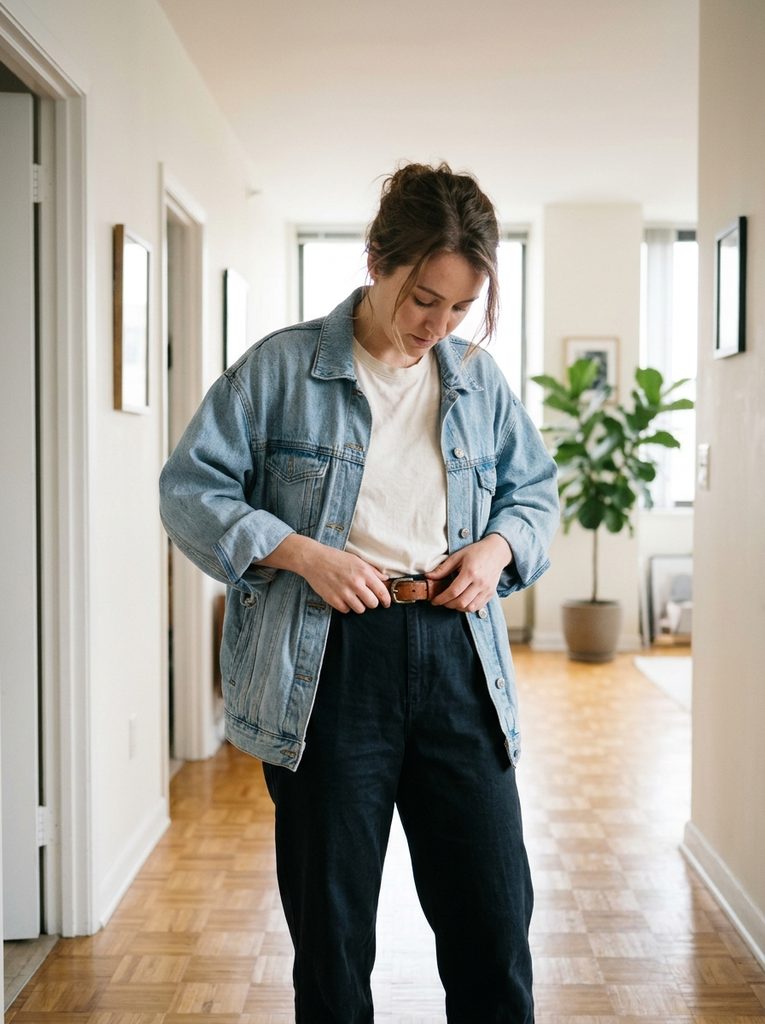
2. Straight-Leg Trousers
Big jacket + tucked top + defined waist
Straight trousers sit in the middle ground. Pick ecru or stone trousers, tuck in a plain tee, and add a thin belt. Roll the jacket sleeves once so the wrists show. Loafers or low-profile sneakers complete the look.
The tuck and the belt do the structural job here. Without them, straight trousers and a boxy jacket blend into one long block.
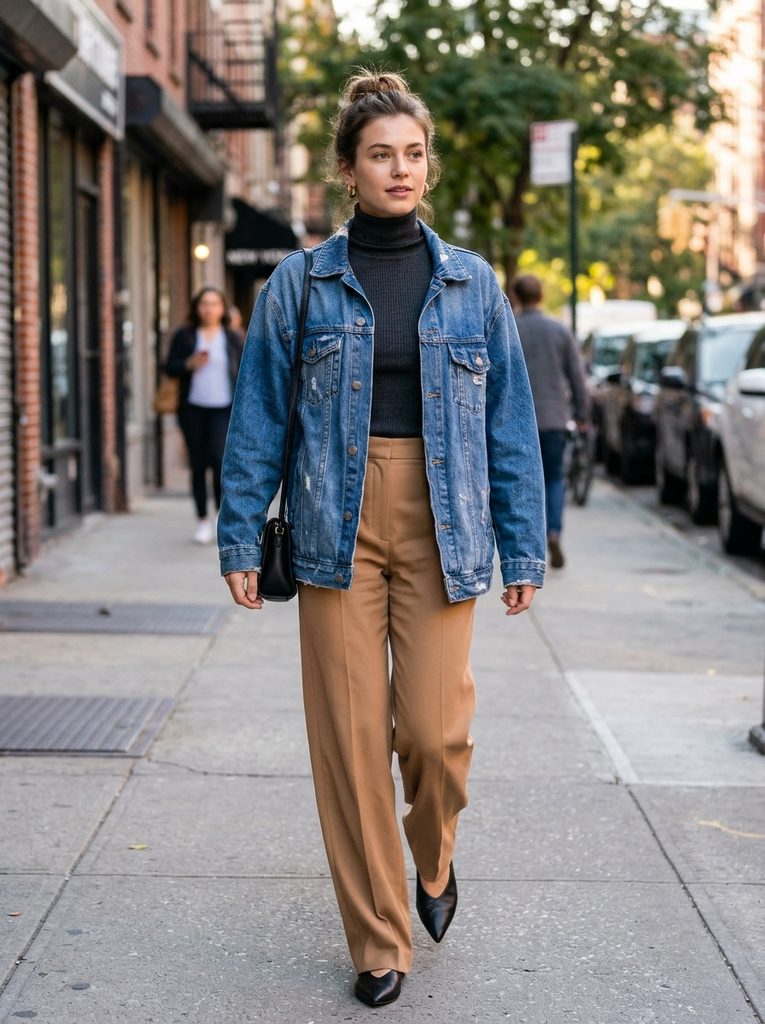
3. Wide-Leg Trousers
Big jacket + fitted middle + wide leg + shorter hem
Volume on top and volume below is the hardest pairing, yet it looks great when handled carefully. Dark wide-leg trousers with a fitted turtleneck tucked in create a narrow middle. Push the jacket sleeves up to the elbow, and finish with pointed flats.
Keep the jacket hem at or above the hip. A longer jacket over wide trousers can turn the outfit into a rectangle.
4. Mini Skirts and Short Hems
Big jacket + tucked top + bare or sheer legs
A short skirt gives the jacket a counterweight of visible leg. A pleated mini, a tucked tee, opaque tights, and clean sneakers keep the look light. The jacket hem should fall clearly longer than the skirt, or just match it, so the two do not clash halfway.
In cold weather, thick tights keep the leg line smooth and add warmth.
5. Midi and Maxi Skirts
Big jacket + fitted tank + long, slim skirt
A ribbed knit midi skirt in grey or chocolate brown falls straight down the body, which narrows the lower half. Add a fitted tank and wear the jacket open. Flat boots or slim loafers keep the line clean.
The open jacket acts like two vertical panels. They frame the narrow column beneath, and the whole outfit looks taller.
6. Dresses
Big jacket + fitted dress + visible hem
A fitted knit dress is the simplest partner. A rib-knit mini dress, tights, and ankle boots work well, with the jacket left open. The dress hem should show below the jacket by a few inches, or the outfit can look like nothing is underneath.
For longer dresses, belt the dress and then add the jacket on top. The belt line stays visible when the jacket is open.
7. Leggings and Bike Shorts
Big jacket + fitted athletic base + clean shoes
This is a casual, errand-friendly combination. Leggings and a fitted long-sleeve tee provide the narrow base, and a long oversized jacket adds the outer layer. Clean white sneakers lift it from gym wear to a styled outfit.
Keep colors tight. Black or grey leggings with a mid-wash jacket look planned, while three or four competing colors look random.
8. Layering Underneath
Big jacket + thin layers only
An oversized jacket already adds bulk, so the layers under it should stay slim. A fine turtleneck or a thin knit works better than a chunky sweater. The jacket then sits comfortably, without pulling across the shoulders or bunching at the sleeves.
If extra warmth is needed, a long wool coat over the jacket can handle it better than a thick sweater under it.
Sleeves, Hems, and Other Small Fixes
A handful of adjustments can change an oversized jacket in under a minute.
- Roll the sleeves. Fold the cuff over once or twice so the wrist shows. A neat roll looks intentional, while a messy bunch does not.
- Push them to the elbow. This works well in mild weather and instantly adds a more relaxed feel.
- Tuck the front hem. If the jacket is long, pulling the front of the hem behind the hip opens up the waist.
- Button one or two buttons. Leaving the jacket entirely open is easy, but a single closed button at the waist creates shape.
- Belt over the jacket. A thin belt around the jacket works best with longer styles, and it turns the extra fabric into a defined waist.
- Think about a tailor. Shoulders are the hardest part to fix, though a tailor can often shorten sleeves or adjust the hem at a small cost.

Different Heights, Same Rules
Height changes how much extra fabric looks like too much.
On shorter frames, the main danger is that the jacket covers too much of the body. Staying with a cropped oversized cut, or one that ends right at the hip, keeps the legs visible. Monochrome outfits help, since one continuous color creates a longer line. For more ideas on keeping proportions neat, this guide to petite-friendly dresses for fall and winter covers hem lengths that work well under jackets.
On taller frames, there is more room for length. A hip-length or longer oversized jacket suits wide-leg trousers, maxi skirts, and long boots without swallowing the figure. A slightly longer sleeve also looks natural, since arms are longer too.
For all heights, the quick test is the same. Look in the mirror from the side. If the jacket hem, the top of the legs, and the shoes form a pleasing set of lines, the proportions are working.
Washes, Colors, and Fabric Weight
The jacket itself changes how easy these formulas are.
Denim comes in different weights, and the weight decides how the volume behaves. Heavy denim holds its shape and stands away from the body, which suits a boxy look. Lighter denim drapes more and moves with the body, so it can feel less bulky.
Color adds another layer. A dark wash leans more polished and hides the bulk. A light wash looks more casual and shows every fold. Black reads sleeker still. For something warmer, brown denim has its own set of ideas, covered in this post on brown denim outfit ideas for fall.
If the jacket is very light in color, keep the rest of the outfit in matching or deeper tones. High contrast between a light jacket and dark pieces makes the jacket look larger.

Bags and Shoes That Suit Big Jackets
An oversized jacket changes how accessories look, since there is so much fabric at the hips and shoulders.
A structured bag gives the outfit a firm edge against the soft denim. Shoulder bags that rest at the hip can bunch the jacket, so a crossbody or a handheld shape sits better. If size is a question, this guide to handbag sizes worth owning shows how each one behaves on a normal day.
For shoes, slimmer shapes balance the volume above. Loafers, pointed flats, ankle boots, and sleek sneakers all work. Very chunky shoes can look heavy beneath a big jacket, though they suit relaxed outfits with wide trousers.
A Quick Mirror Test
Before leaving the house, a short check catches most problems.
- Front view. Can you see a waist, an ankle, or a wrist?
- Side view. Does the jacket hem sit at a flattering point, not at the widest part of the hip?
- Back view. Is the fabric draping smoothly, or bunching at the lower back?
- Arms raised. Does the jacket lift awkwardly, or does the outfit stay in place?
If one answer is no, a single adjustment, such as a tuck, a roll, or a belt, usually fixes it.
Leave One Zone Fitted
Oversized jean jacket outfits work for the same reason any outfit works: the eye finds a clear shape somewhere. The jacket supplies the ease, and one other part of the look supplies the definition.
So the next time the jacket feels like too much, ask which zone is fitted. If the answer is none, add a tuck, a belt, or a slimmer pair of trousers. If the answer is two or three, loosen one of them. Once that balance is found, the same jacket works across seasons and outfits, and it looks chosen, not borrowed.

Ella is a fashion and beauty writer who shares inspiring ideas about hairstyles, nail designs, wedding outfits, and seasonal fashion trends. She loves discovering fresh styles and creating…
View Author Profile →