

On this page
- Midi or Maxi? A Quick Way to Tell
- The Gap Below the Hem
- Looks Built Around Trousers
- Looks Built Around Skirts and Dresses
- Looks Built Around Boots and Bare Ankles
- What Goes on Top: Collars, Scarves, and Belts
- How Fabric Changes the Outfit
- Maxi Coat Problems and Quick Fixes
- Pick the Gap First, Then Everything Else
Stand in front of a mirror in a long coat and look only at the bottom six inches. That strip, where the hem meets whatever is underneath, decides more than the color, the fabric, or the brand. A good one makes the coat look tall and deliberate. A bad one makes it look borrowed.
Most advice about long coats talks about warmth. This guide is about the lower half of the picture: how a midi or maxi hem meets trousers, skirts, and boots. It starts with a quick way to tell the two lengths apart, then covers eight looks, the top-half details, and the fixes for common problems.
Midi or Maxi? A Quick Way to Tell
The words get used loosely, and shops disagree on them. A simple test works better than a label.
A midi coat ends somewhere between just below the knee and the middle of the calf. A maxi coat ends near the ankle or lower. If the hem touches the widest part of the calf, it is a midi. If it passes that point and heads for the ankle bone, it is a maxi.
Each length does something different:
- Midi coats leave the lower leg partly visible, so boots and trouser hems stay part of the outfit. They move easily on stairs and in cars.
- Maxi coats cover nearly everything, which means more warmth and a bolder outline. They also need more care around puddles and doorways.
Height changes the feeling too. On a taller frame, both lengths look elegant. On a shorter frame, a midi that ends just below the knee often looks neater than a maxi that pools near the shoe. That does not rule out maxis for shorter people. It just means the fit around the shoulders and the hem needs a closer look.
The classic overcoat was once knee-length. Longer versions grew popular as people wanted more cover and a cleaner line, and today both lengths sit comfortably in winter wardrobes.

The Gap Below the Hem
Three things meet at the bottom of a long coat: the coat hem, the leg, and the top of the shoe. How they relate is what people notice first.
The simplest way to think about it is a choice between two clean answers.
Option one: a clear gap. The hem ends well above the boot or shoe, and a section of leg or trouser shows between them. The gap should look wide enough to be deliberate, roughly a hand’s width or more.
Option two: a full overlap. The coat hem lands lower than the boot top, so nothing shows between them. This is common with tall boots and maxi coats.
The awkward zone sits in between. A hem that stops one inch above a boot top, or that grazes the top of a loafer, looks accidental. Moving the shoe, the trouser length, or even the coat’s buttons usually solves it.
A second rule helps too. Keep the visible sections of the lower half narrow. A long coat already makes a wide column from shoulder to calf. Slim trousers, a straight skirt, or a fitted boot gives the eye something sharp to land on.

Looks Built Around Trousers
Trousers are the easiest base for a long coat. They keep the outline clean and work with nearly every shoe.
Straight Trousers, Chelsea Boots, and a Midi Wool Coat
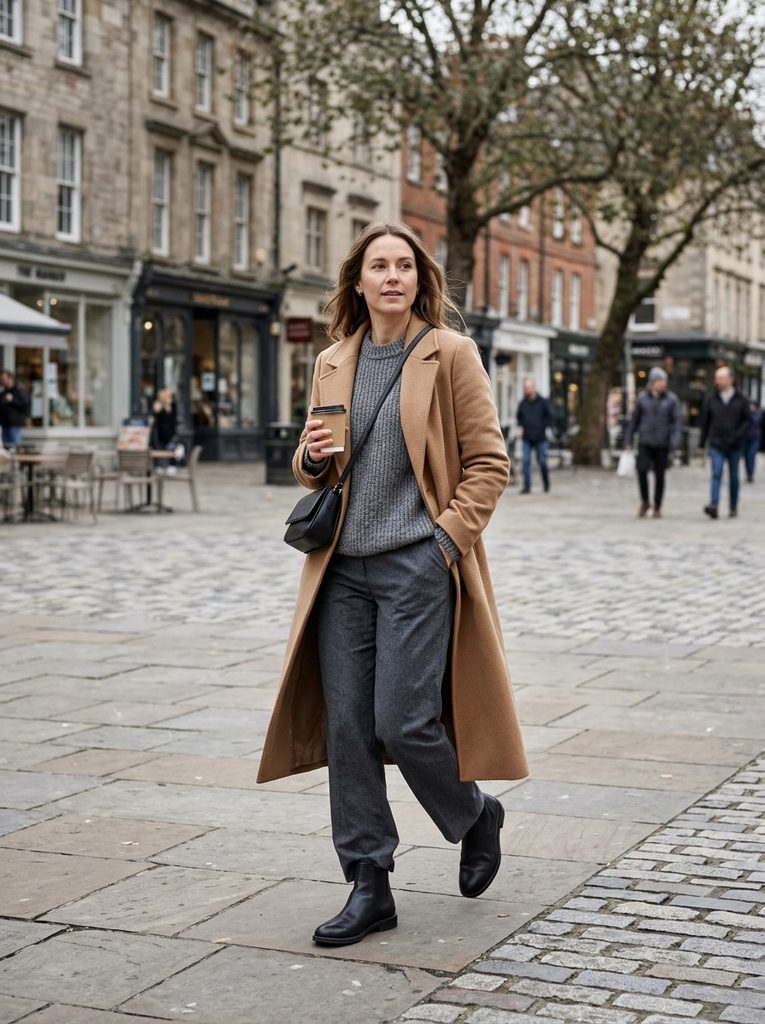
Straight trousers in charcoal or navy hang to the top of the shoe. Chelsea boots have a smooth, close-fitting shape, so the trouser hem sits neatly over the ankle. Add a fine knit and a midi coat in camel or grey.
The hem of the coat lands a few inches above the trouser break, which makes a clear gap and keeps the outfit lean.
Cropped Slim Trousers Under a Maxi Coat
When the coat reaches the ankle, the bottom half should stay slim and light. Ankle-length trousers show a small section of skin or sock above a low shoe. A loafer in black or brown, with a thin sock in a matching tone, makes the lower edge tidy.
Wide-leg trousers can work with a maxi coat, but the volume stacks quickly. A narrow leg keeps the outline in control.
A Tonal Column in Two Shades
Choose trousers a few shades lighter or darker than the coat. A chocolate coat with mocha trousers, or an oatmeal coat with cream trousers, creates one long line. A knit in a middle tone ties the two together, and shoes in the darkest shade ground the whole outfit.
This look suits maxi coats well, since the long continuous color makes the outline look taller.

Looks Built Around Skirts and Dresses
Skirts add movement under a long coat. The main question is the hem, and the answer is again between a clear gap and a full cover.
A Pleated Skirt Longer Than the Coat
This one is slightly unexpected. A satin or crepe pleated midi skirt hangs a few inches lower than a midi coat, so a ribbon of fabric shows underneath. The two hems create layers instead of a straight line, and the movement of the pleats softens the structured coat.
Keep the colors close, such as a grey coat over a charcoal skirt, so the effect looks soft instead of mismatched. Flat boots or sleek loafers finish it.
A Knit Dress With Tall Boots
A fitted knit dress in a neutral shade gives a maxi coat a smooth base. Tall boots in leather or suede cover the leg, and the coat hem overlaps their tops. Because everything below the coat is hidden, the shape that shows is the collar, the waist, and the shoes.
Opaque tights in the same tone as the boots make the lower half look continuous.
A Mini Skirt Under a Midi Coat
Short skirts work, as long as the coat does most of the covering. A leather-look or wool mini hides under a midi coat when it is closed and appears as a flash of fabric when the coat opens. Add tall boots and thick tights.
For help with shorter frames, these petite-friendly dresses for fall and winter include hem lengths that sit well under long outerwear.

Looks Built Around Boots and Bare Ankles
Shoes do a lot of the work under long coats, since they are one of the few things that always show.
Knee-High Boots and a Midi Coat
This is one of the cleanest pairings. The boot top rises to the knee, and the coat hem lands at mid-calf, so the two overlap by a few inches. Nothing breaks the line from hem to toe. Suede and smooth leather both work, as long as the boot shaft fits the calf closely.
If the exact overlap is unclear, this guide to knee-high boot outfits across hemline lengths helps match boot height to a longer hem.
Loafers, Thick Socks, and a Maxi Coat
For days that are cold but not bitter, a loafer with a thick ribbed sock shows a small piece of leg between hem and shoe. Pick cropped trousers or a short pair of tights so the sock reads as a choice. Cream or grey socks suit most coat colors.
This look feels relaxed, and it keeps the shoes dry because a loafer sits clear of the wet pavement.

What Goes on Top: Collars, Scarves, and Belts
The upper half is where a long coat gets personality. Since the bottom is already a large block of fabric, small changes up top matter.
- Collar. A fine turtleneck under the coat adds a clean neckline and keeps drafts out. A wide-open collar looks more relaxed but needs a scarf on colder days.
- Scarf. Draping a scarf loosely and letting the ends hang adds length, while a tight wrap gives a neater, shorter line. A scarf in a tone close to the coat blends in, and one in a contrasting color becomes the accent.
- Belt. A belt over the coat marks the waist and breaks up the long vertical. This helps most with maxi coats, which can look like columns without any shaping.
- Buttons. Leaving the bottom button or two undone gives the legs room to move and shows a little of what is beneath the hem.
- Hats and gloves. A soft knit hat or leather gloves add detail without adding volume.
Bags matter too. A structured shape sits more neatly against a wool surface than a slouchy one, and these handbag sizes worth owning show how each size behaves on a normal day.

How Fabric Changes the Outfit
Two coats of the same length can behave very differently depending on what they are made of.
Wool and wool blends hold a shape and fall straight. They suit structured outfits and look sharp in dark colors. Heavy versions can feel stiff at first, though they relax with wear.
Wool with a little cashmere drapes more softly. It moves with the body and feels gentler against a scarf. It does show wear sooner, particularly under bag straps.
Double-faced wool has two finished sides and usually no lining. The edges look clean, and wrap fronts hang smoothly. It works well for midi lengths with a belt.
Down-filled maxi coats are the warmest option. Their quilted channels create vertical lines, which can make the outline look taller. They are better in dry cold than in wet slush.
Pile and teddy fabrics are soft and visual. They add texture, so the rest of the outfit should stay plain.
The best winter coats for women covers more on fabrics and construction if a new coat is on the list.
Maxi Coat Problems and Quick Fixes
Long coats create a few predictable annoyances. Most have simple answers.
The hem drags in wet weather. Shoes with a thicker sole lift the wearer slightly, and a tailor can shorten the hem by an inch or two. A midi cut avoids the issue altogether.
The coat feels like it is swallowing the outfit. Add a belt, keep the layers underneath thin, and make the bottom half narrow. A slim pair of trousers does more than any accessory.
It rides up when sitting. Unbutton the lower buttons before sitting down. Wrap coats can be loosened at the belt.
The shoulders slide down. A coat that is too wide in the shoulders will never look right. The seam should sit near the edge of the shoulder, unless the coat is deliberately oversized.
Static and lint cling to the fabric. A quick pass with a lint roller or a clothes brush helps. Dark coats show everything, so a small brush by the door is worth having.
The coat gets caught in car doors and on stairs. Gather the front in one hand when climbing stairs, and tuck the hem in before closing the door. It becomes automatic after a few days.
Pick the Gap First, Then Everything Else
Long winter coat outfits are easier when the hem is treated as the starting point. Decide whether the outfit shows a clear gap or a full overlap, and the choice of boots, trousers, or skirts follows naturally.
Next, keep the visible lower half narrow, add one detail on top, and make sure the shoulders fit. That covers most of what separates a coat that looks chosen from one that looks like it is wearing the person. A midi or a maxi can work well. It just needs a plan for the bottom six inches.

Ella is a fashion and beauty writer who shares inspiring ideas about hairstyles, nail designs, wedding outfits, and seasonal fashion trends. She loves discovering fresh styles and creating…
View Author Profile →




1 Comment