
On this page
- What Makes a Reception Different From the Rest of the Day
- The Anchor Point Does More Work Than the Visible Style
- Braided Crowns and Why They Outlast Simple Twists
- Building in Room for Natural Loosening
- Preparing for Heat, Sweat, and a Long Dance Floor
- Half-Up Styles and Veil Removal Partway Through the Night
- Matching the Half-Up Technique to Hair Type
- What to Actually Test at a Trial for Reception Durability
- Common Reasons a Half-Up Style Doesn’t Make It Through the Night
- Planning a Half-Up Style That’s Built for the Whole Night
A half-up style almost always looks perfect in the getting-ready photos. Hair is fresh, the twist or braid at the crown is crisp, and everything sits exactly where the stylist left it an hour earlier. The real test doesn’t happen until much later, somewhere between the first dance, a few hours of hugging relatives, and whatever the dance floor does to a style that was only ever tested standing still.
Most half-up guides focus on how to build the style in the first place. Fewer talk about what actually happens to that style once a reception’s specific demands, heat, movement, repeated contact, sweat, hours on end, start working against it. A half-up look that survives a hair trial and photos beautifully can still come apart by the second hour of dancing if it wasn’t built with those specific stressors in mind from the start.
What Makes a Reception Different From the Rest of the Day
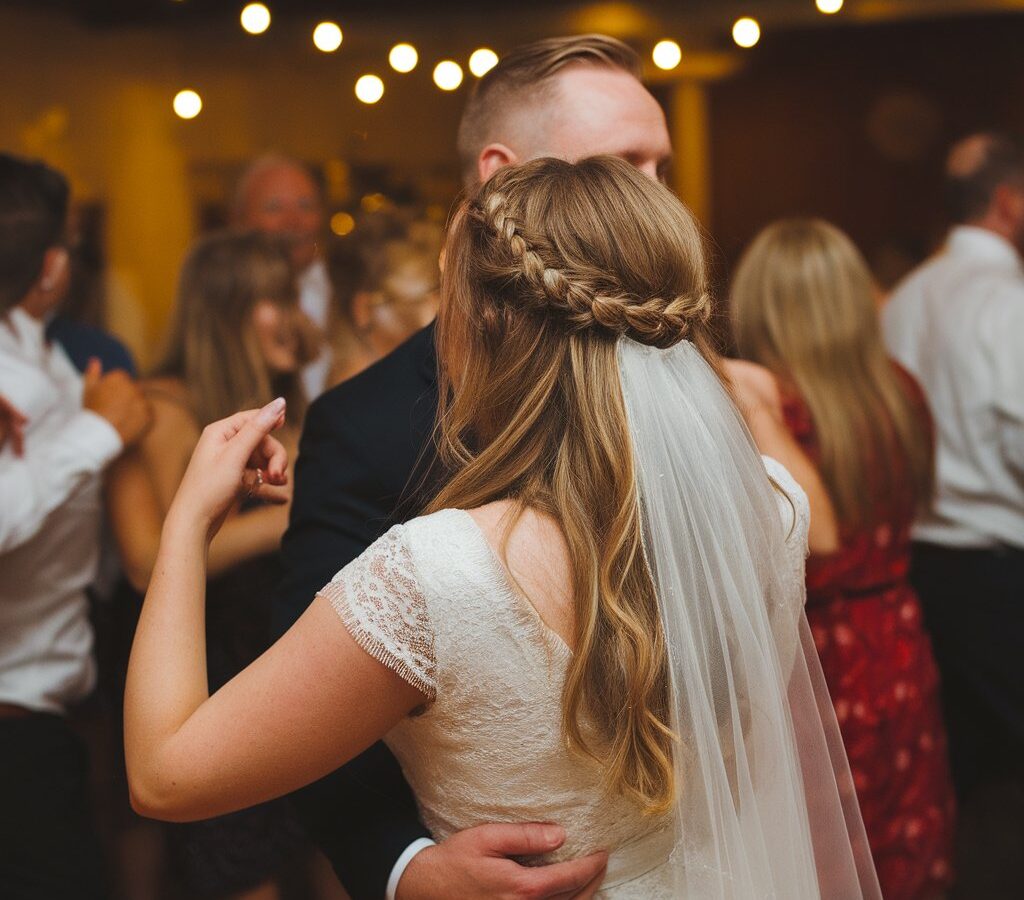
Ceremonies are relatively gentle on hair. There’s some standing, some walking, maybe an emotional hug or two, but the overall movement is contained and the pace is slow. Receptions are a different category of wear entirely.
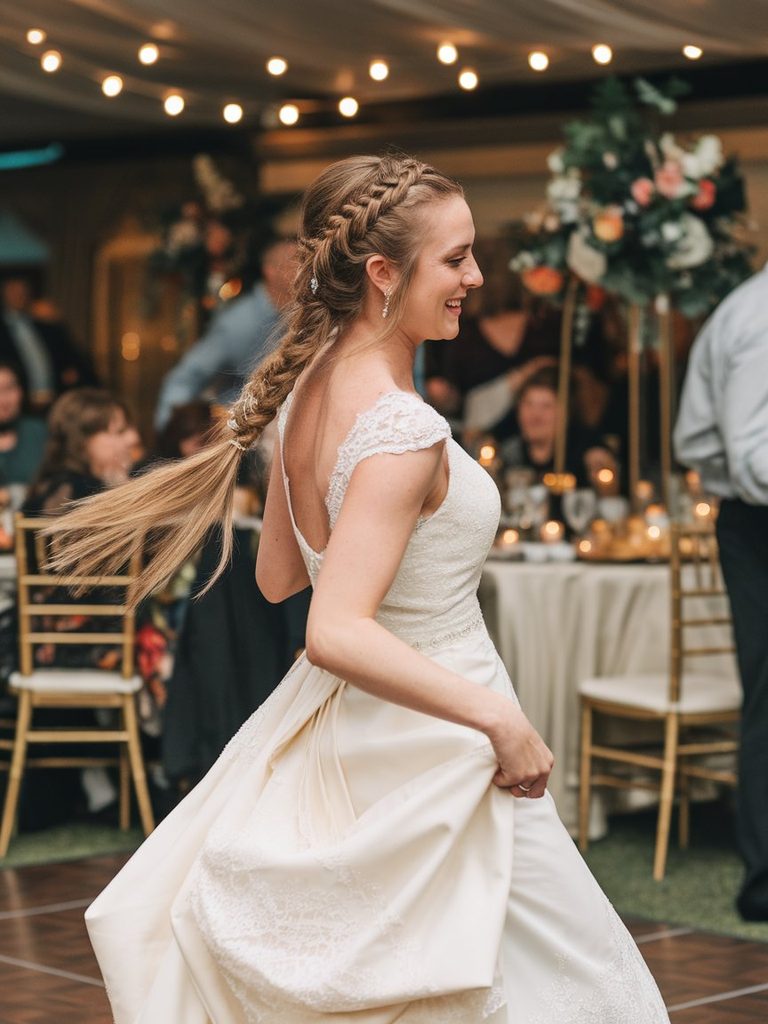
Dancing introduces repeated, often vigorous head movement over an extended period, sometimes hours, which puts far more ongoing stress on pins and structure than anything earlier in the day. Body heat from a crowded room, combined with any exertion on the dance floor, raises the ambient temperature around the hair in a way that can soften hold products and loosen a set style faster than it would in a cooler, calmer setting. Repeated hugging and cheek-to-cheek contact, especially during a receiving line or throughout an open reception, puts direct pressure on any hair near the sides of the head. And simply put, a reception lasts longer than a ceremony does, often four or five hours or more, which means a style needs to hold not for one set of photos but for an entire evening of continuous wear.
A half-up style built only with the ceremony and portraits in mind, tested at a trial that ends once photos are taken, is being tested for roughly a third of what it will actually need to survive.
The Anchor Point Does More Work Than the Visible Style
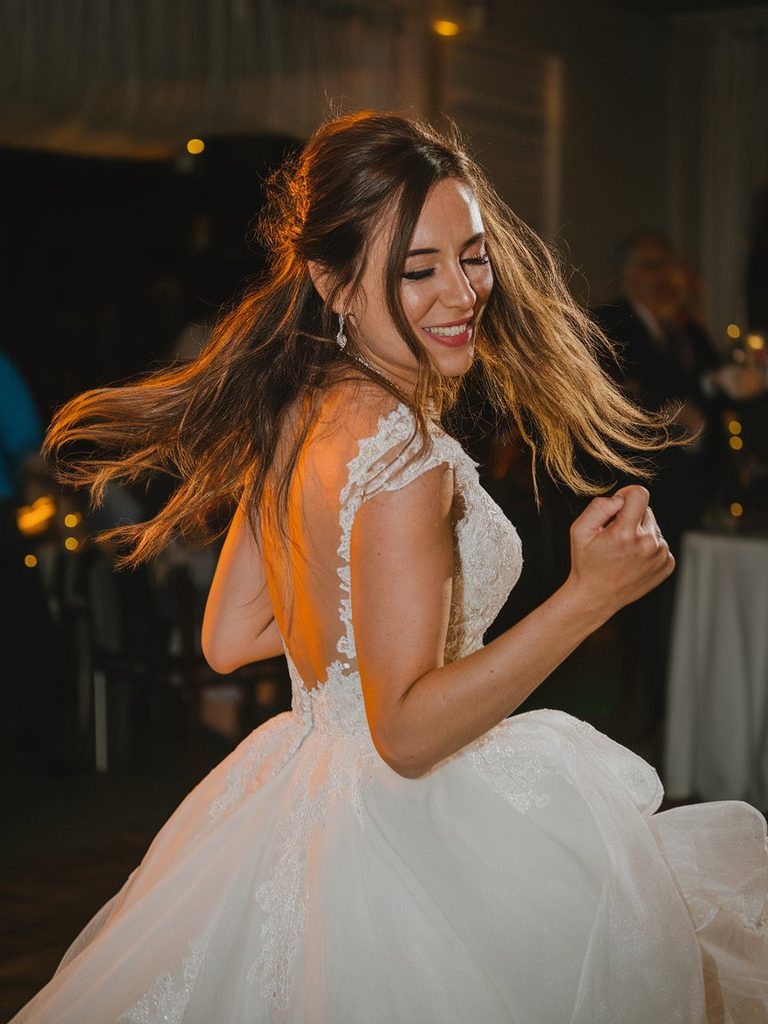
The visible part of a half-up style, the twist, braid, or pinned section at the crown, gets most of the attention during planning, but the actual structure holding everything together sits underneath it, largely invisible in photos.
A half-up section built with a genuine base, a small section backcombed at the root before the twist or braid is formed, gives pins something substantial to grip rather than just smooth, slippery strands. This base layer is what keeps the whole half-up section from slowly working its way loose as the evening goes on, even when the visible twist or braid on top still looks intact.
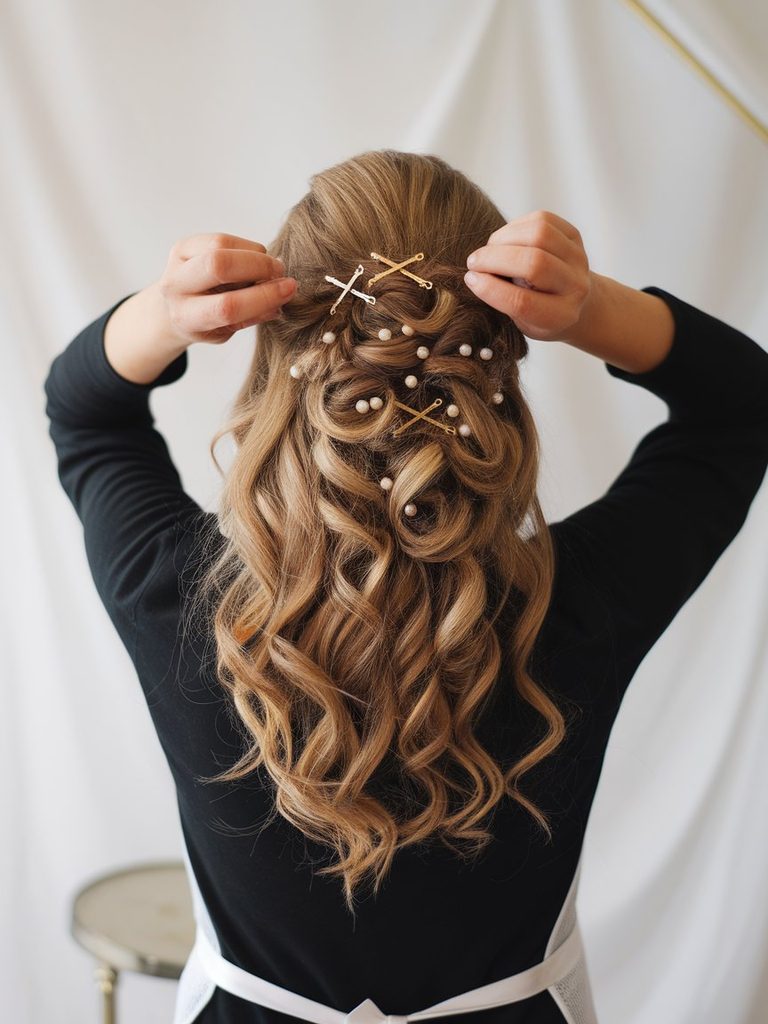
Pins placed in a crossed or X pattern, rather than parallel to each other, distribute tension more evenly and resist slipping out during repeated movement far better than a single row of straight pins does. This is a small technical detail that makes a disproportionate difference by hour three of a reception, when straight-set pins have often already started to loosen.
Braided Crowns and Why They Outlast Simple Twists
Not every half-up technique holds up equally well under hours of movement, and braided structures generally outperform simple twists specifically because of how they distribute tension.
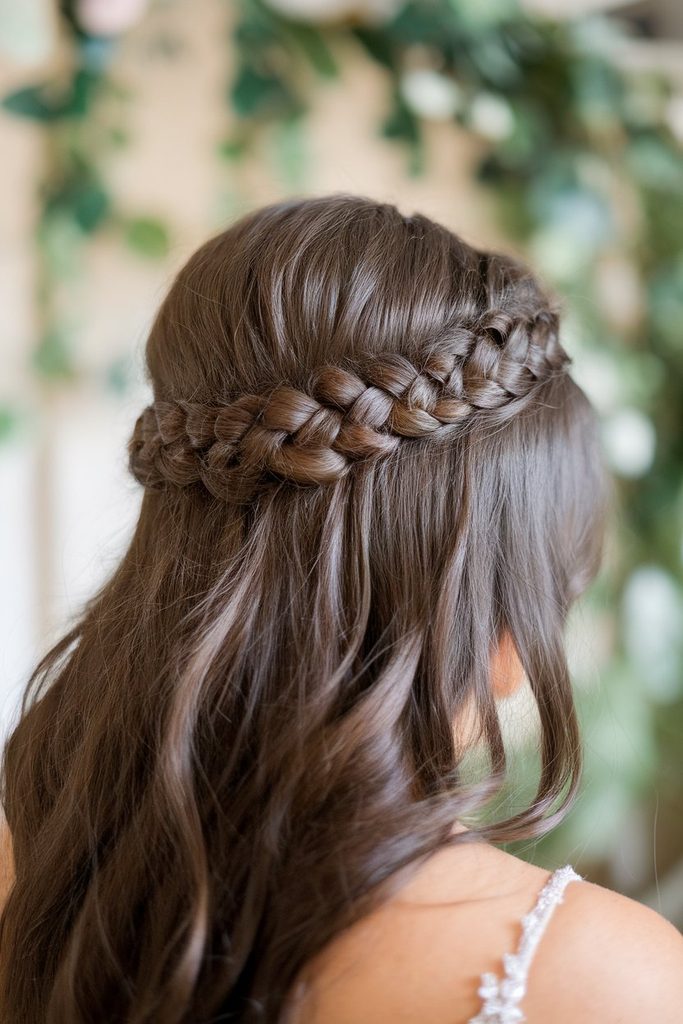
A French braid or Dutch braid worked from the crown backward locks hair into a woven structure that resists slipping in a way a single twisted section can’t fully match, since the braid itself is mechanically interlocked rather than just coiled and pinned. A pancaked braid, gently pulled apart at the edges after braiding for a fuller look, holds this same structural advantage while still reading as soft and romantic rather than tight or severe.
A simple twisted half-up section, while faster to create and often preferred for its cleaner look, relies more heavily on pins alone to maintain its shape, which makes it more vulnerable to loosening under repeated dance-floor movement than a braided equivalent. This doesn’t rule twists out entirely, but it does mean a twisted half-up style benefits from extra reinforcement, doubled pins or a small amount of hairspray worked directly into the twist itself, if it needs to survive a long, high-energy reception.
Building in Room for Natural Loosening
Paradoxically, a half-up style that’s pinned into an absolutely rigid, zero-movement state at the start of the day sometimes fails faster than one built with a small amount of intentional flexibility.
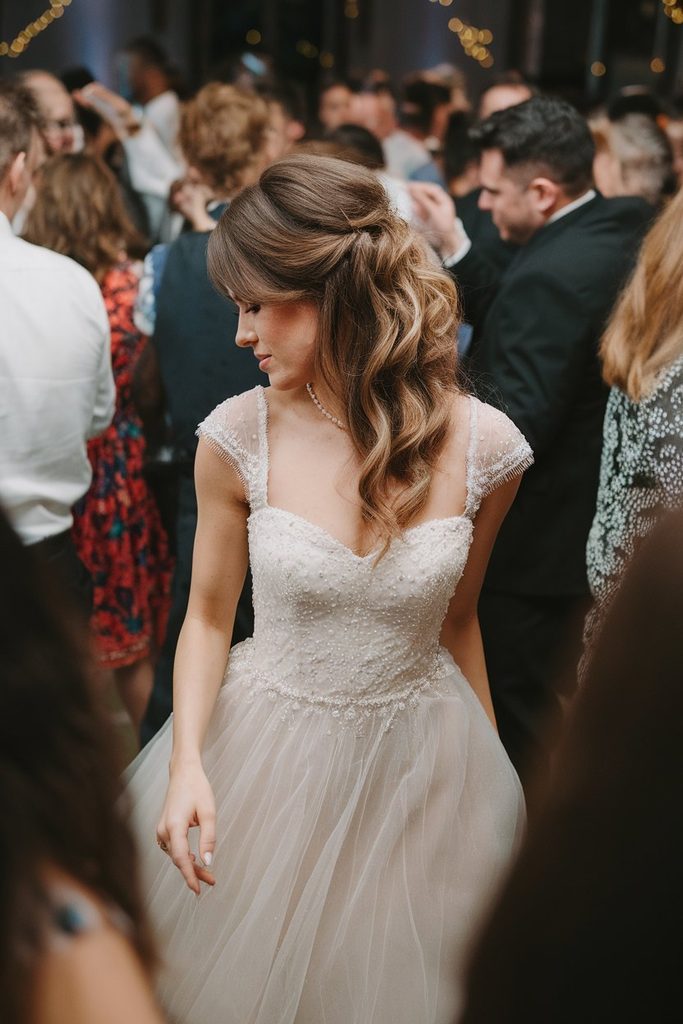
Hair that has nowhere to give under pressure tends to pull pins loose entirely rather than simply loosening gradually. A half-up section with a few strategically placed pins left slightly less tight than the rest, combined with a light-hold finishing spray rather than a stiff, heavy one, allows the style to soften naturally over several hours without collapsing outright. This is part of why a half-up style photographed at hour four of a reception often looks slightly more relaxed than it did at hour one, without looking undone, since a small amount of movement was already built into the plan.
A stylist who understands this distinction will often intentionally under-tighten certain sections during the initial styling, trusting that the day’s movement will settle the style into its final, most flattering shape rather than fighting to keep everything artificially rigid from the very first pin.
Preparing for Heat, Sweat, and a Long Dance Floor
Reception environments run warmer than most other parts of the wedding day, and that heat interacts with hairstyling products in ways worth planning around.
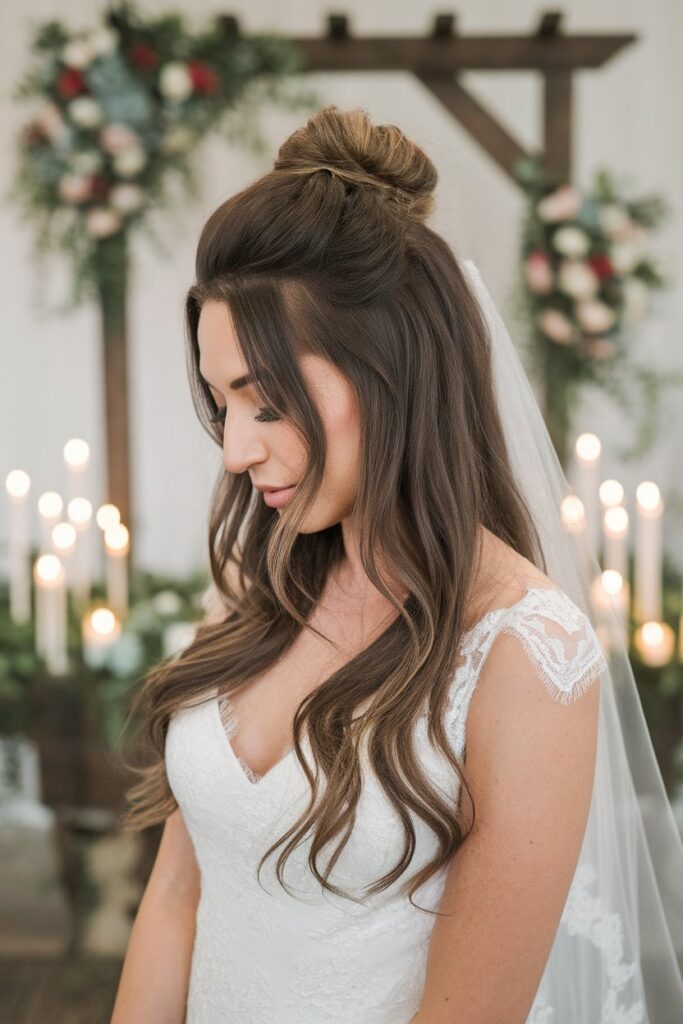
A lightweight, heat-resistant finishing spray, rather than a standard hairspray that can feel tacky or start to soften under warmth, holds up better through hours in a warm room. Starting the half-up section slightly higher and tighter than the desired end-of-night look gives the style room to relax into its intended shape as the evening warms up, rather than starting at the target look and only loosening from there.
For brides expecting an especially active reception, requesting a small touch-up kit, a few matching bobby pins, a travel-size version of whatever finishing product was used, and a small comb, tucked into a bag or left with a bridesmaid, makes a five-minute bathroom touch-up possible without needing to track down the original stylist mid-reception.
Half-Up Styles and Veil Removal Partway Through the Night
Many brides remove their veil at some point during the reception, and a half-up style needs to hold its shape through that transition as well as through everything before it.
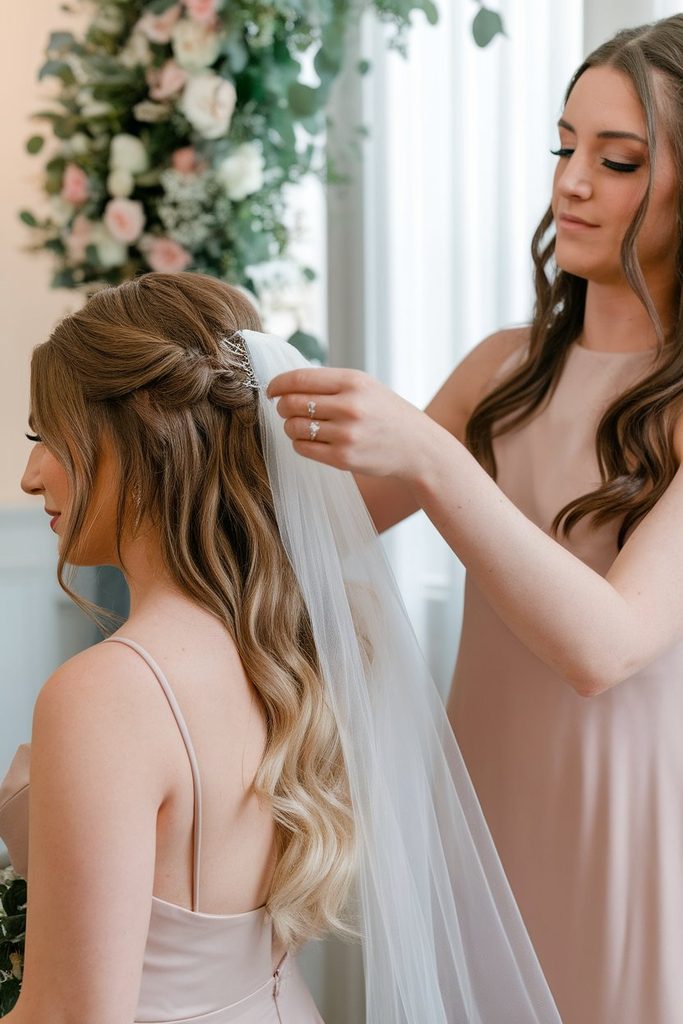
Because a veil comb is often anchored into the same crown section that anchors the half-up style itself, removing it can disturb the pins underneath if it’s pulled quickly or carelessly. Taking the same slow, careful approach used to prevent tangling and damage during veil removal protects the half-up structure underneath just as much as it protects the hair itself, since a rushed removal is one of the more common reasons a previously solid half-up style suddenly looks disheveled partway through the reception.
Asking a stylist to double-check the pins directly beneath the veil comb once it comes off, rather than assuming the half-up structure is still fully intact, catches small loosening before it becomes visible in the rest of the evening’s photos.
Matching the Half-Up Technique to Hair Type
Reception durability isn’t only about technique, hair type changes how long any given half-up structure realistically holds, and planning around this honestly produces better results than assuming one approach works for everyone.
Fine, thin hair tends to lose hold faster under heat and movement than thicker hair does, simply because there’s less material for pins to grip. A slightly more built-up base, more backcombing, a few extra hidden pins, compensates for this without changing the overall visible style. Thick or coarse hair generally holds a half-up structure longer without intervention but can pull pins loose through sheer weight if the base section isn’t secured firmly enough at the start. Naturally curly or coily hair often holds a half-up braid or twist exceptionally well through movement, since the hair’s own texture adds grip that straight hair doesn’t have, though humidity can still soften the style’s edges over several hours regardless of texture.
What to Actually Test at a Trial for Reception Durability
A trial that ends the moment the style looks good in a mirror isn’t testing what actually matters for a reception, since the mirror moment is the easiest part of the day for any style to pass.
Asking a stylist to check the style again after an hour or two of normal activity, running errands, sitting through a meal, moving around, gives a far more honest read on how the half-up section will actually hold than judging it immediately after the last pin goes in. If at all possible, testing some actual movement, a few turns of the head, even a bit of dancing in place, reveals whether the chosen technique and pin pattern will realistically survive a real dance floor rather than just a stationary photo.
It’s also worth discussing directly with a stylist how the venue’s specific conditions, an un-air-conditioned barn reception in summer versus a climate-controlled ballroom in winter, might change how much reinforcement the half-up section needs, since a style that holds fine in a cool trial appointment can behave very differently in a warm, crowded room months later.
Common Reasons a Half-Up Style Doesn’t Make It Through the Night
A handful of recurring issues account for most of the disappointment brides describe with a half-up style that looked great early on and fell apart later.
- Relying on a simple twist with minimal reinforcement. Twists look clean but depend more heavily on pins alone than braided structures do, making them more vulnerable to hours of movement.
- Skipping a proper base section under the visible style. Without some backcombing or texture at the root, pins have little to grip, regardless of how carefully the visible twist or braid is built.
- Using a heavy, stiff-hold spray in a warm venue. Certain finishing products can soften or feel tacky under heat rather than holding firm, undermining the structure they’re meant to protect.
- Never testing the style under real movement before the wedding. A style judged only in a stationary mirror check hasn’t actually been tested against what a reception demands.
- Removing the veil quickly without checking the pins underneath. This is one of the most common moments a previously solid half-up structure visibly loosens partway through the evening.
Planning a Half-Up Style That’s Built for the Whole Night
A half-up style that survives a full reception isn’t a different style from one that only survives photos, it’s the same style built with a different set of priorities from the start. Braided structure over simple twists, a proper base section rather than pins alone, room for natural loosening instead of rigid tightness, and a trial that tests real movement rather than a single still moment all add up to a look that still holds its shape by the time the last song plays.
Brides finalizing hair plans around this stage often want the rest of the bridal-day details settled at the same time. The guide to wedding dress necklines by body shape is a useful stop for anyone still deciding on a gown, and brides who haven’t fully committed to half-up over a full updo may want to compare notes with what makes a down or half-up bridal style hold up in general before finalizing their choice.

Ella is a fashion and beauty writer who shares inspiring ideas about hairstyles, nail designs, wedding outfits, and seasonal fashion trends. She loves discovering fresh styles and creating…
View Author Profile →