


On this page
- What Makes a Mix Look Deliberate
- Repeat Each Metal at Least Twice
- Use a Bridge Piece
- Balance the Weight and Proportion
- Vary the Finish and Texture
- Zone by Zone: Where to Mix
- Beyond Jewelry: The Other Metals in Your Outfit
- Matching the Mix to What You Are Wearing
- Undertone and Personal Preference
- Four Ready-Made Combinations
- When It Is Better to Match
- Care and Storage
- Mistakes That Make a Mix Look Accidental
- Building a Mixed-Metal Core Collection
- FAQs
- A Small Final Check
Most mixed-metal outfits go wrong in the same way. One silver ring sits among gold bracelets, or a gold hoop appears beside a silver chain, and the whole thing reads as a mistake rather than a choice. The metals themselves are rarely the problem. What gives it away is how few signals of intent the wearer has put in place.
The old rule against combining the two has largely faded. Jewelry guides now describe the mix as mainstream, and designers cited by The Zoe Report encourage it. What remains is a handful of practical habits that separate a considered mix from a random one. This guide covers them in order: repetition, bridge pieces, weight, finish, placement, and the details beyond jewelry that quietly support the look.

What Makes a Mix Look Deliberate
A mixed-metal look succeeds when the eye can find a pattern. People do not need to consciously notice the pattern; they only need to feel that the arrangement was planned. Four things create that feeling: repetition, a connecting piece, balanced weight, and variety in texture.
Without those signals, even excellent jewelry can look like a handful of items put on at random. With them, a simple gold hoop beside a silver ring and a two-tone watch looks composed. The sections below turn each signal into a habit.
Repeat Each Metal at Least Twice
The single most useful rule is that no metal should appear only once. A lone silver ring among a full set of gold jewelry stands out as a possible oversight. USA Jewels makes the same point: if one silver piece appears among gold, add another silver element elsewhere, so the mix feels planned.
In practice, this means pairing a silver ring on one hand with silver earrings or a silver watch on the other. The repeat does not need to be identical. It only needs to appear in a different part of the outfit, so the eye connects the two.
Spreading the pieces across the body also helps. Gold at the ears and wrist, with silver at the neck and fingers, reads as a pattern. All of one metal in one zone, and a stray piece of the other in a different zone, reads as a mismatch.
Use a Bridge Piece
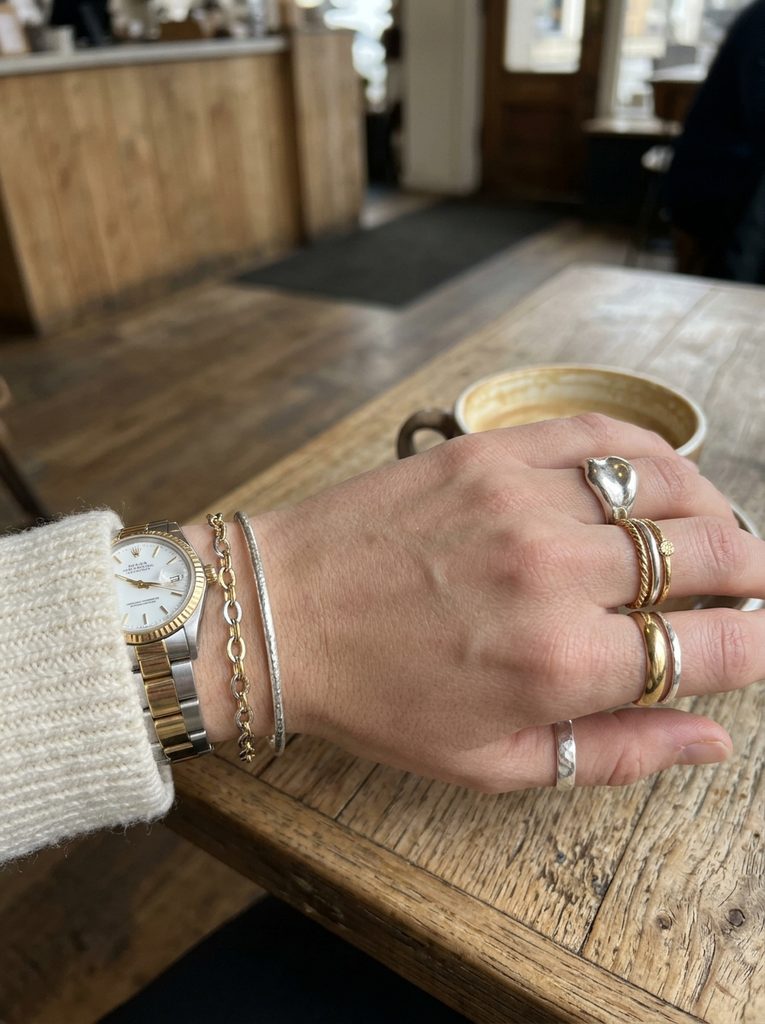
A bridge piece contains both metals, which gives the rest of your jewelry permission to do the same. A two-tone watch, a ring with silver and gold bands, a chain with mixed links, or a bracelet with both tones can all serve.
The Zoe Report quotes a jewelry founder who suggests starting with a piece that holds both metals and building from there. It is a sound approach, because everything else you add can pull from either side of the bridge.
Other Ways to Bridge
Rose gold sits between yellow gold and silver, with a softer, slightly cooler warmth than yellow gold, so it can connect the two tones. White gold also sits comfortably next to silver.
Gemstones set in mixed metals, enamel pieces in both colors, and chunky chain bracelets with alternating links can serve the same purpose. Even a pearl strand with a gold clasp beside silver earrings creates a visual link.
Balance the Weight and Proportion
Beyond color, scale decides whether pieces look related. A heavy gold cuff beside a hair-thin silver chain looks lopsided, because the chain disappears next to the cuff. The pieces need to share enough visual weight to feel like part of the same outfit.
A helpful guide is to choose a dominant metal and a supporting one, rather than splitting everything evenly. A rough ratio of about two-thirds to one-third often looks natural, with the supporting metal appearing in several smaller pieces. This is a styling suggestion, not a fixed rule, and a nearly even split also works when the pieces are all delicate.
When you are not sure which metal should lead, consider what you wear most often. A jewelry designer cited by The Zoe Report suggests leaning heavier on the metal you prefer, and lighter on the other.
Also match the scale of related pieces. A chunky gold necklace pairs well with a chunky silver bracelet. A fine silver chain pairs well with fine gold studs.
Vary the Finish and Texture
Texture is a quiet but effective way to make a mix feel purposeful. A high-shine gold bangle beside a matte silver ring creates a clear contrast that looks chosen. A hammered silver cuff next to a smooth gold chain does the same job.
The reverse can cause problems. Two highly textured pieces in different metals can compete for attention. A very polished gold piece next to a very matte silver one can look disconnected if nothing else links them.
A practical approach is to keep one variable constant. If the metals differ, keep the finish similar, or if the finishes differ, keep the metal consistent in at least some pieces. This keeps the overall effect from feeling busy.
Zone by Zone: Where to Mix
Different parts of the body offer different opportunities. These suggestions treat each area separately.
Ears
Ears are one of the easiest places to mix, especially with several piercings. Alternating tones, such as silver, gold, silver, across a set of studs and small hoops looks tidy. If you wear only one pair, choose a single metal and put the other tone elsewhere.
A pair of mixed-metal hoops, with a gold outer layer and a silver inner one, works as an instant bridge.
Neck
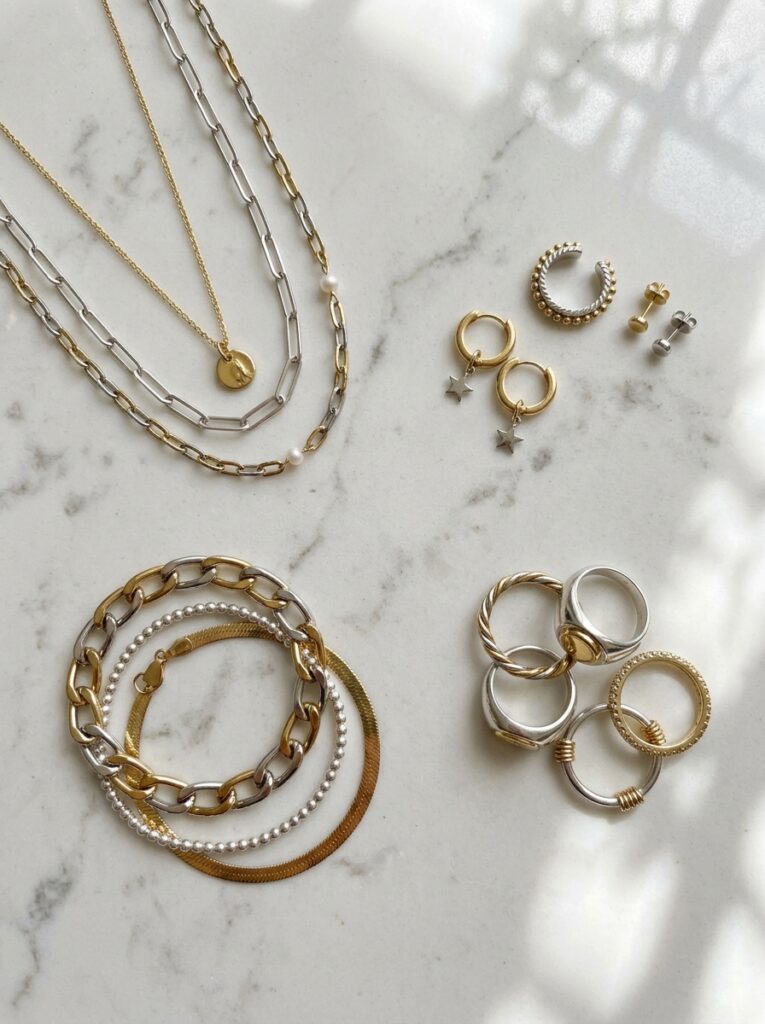
Layered necklaces are well suited to mixing. Pair a short silver chain with a longer gold pendant, so the lengths separate the metals clearly. Add a third piece that uses both tones, or a rose gold chain, to unify the layers.
Keep the chain weights similar. A very fine chain layered under a very bold one tends to disappear.
Hands
Rings give the most room for experimentation. Mixed stacks on the same finger can look chic when the bands share a similar width. Alternatively, wear gold on one hand and silver on the other, then echo each tone in a bracelet.
Wrists
A stack of bracelets can alternate tones along the arm, gold, silver, gold, so no single metal clusters at one end. A watch in either metal can anchor the stack. If the watch is two-tone, it acts as a bridge for everything else.

Beyond Jewelry: The Other Metals in Your Outfit
Jewelry is only one source of metal. Belt buckles, bag hardware, shoe details, glasses frames, buttons, hair clips and zippers all contribute. Taking these into account is often what makes a mix look coherent.
If your bag has gold hardware, wearing mostly gold jewelry, with one or two silver pieces repeated, will look balanced. If your glasses have silver frames, silver earrings echo them naturally.
Pins and brooches count as well. The metal advice in brooch outfit ideas for preppy fall looks applies here too: gold with warm colors, silver with cool tones, and mixed metals only when they are limited and intentional.
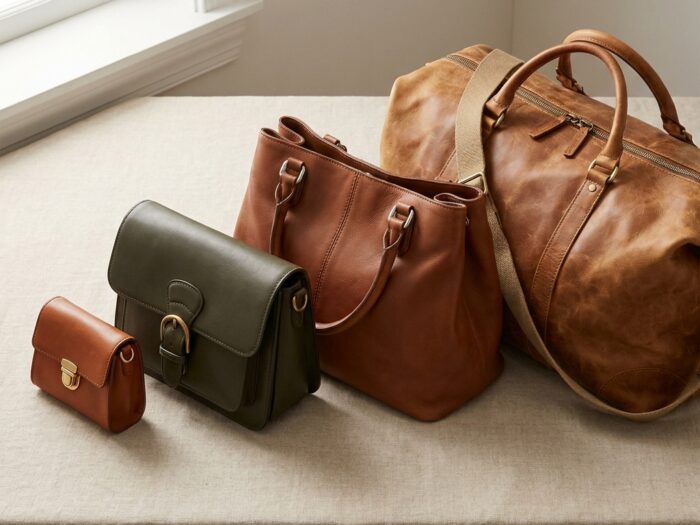
For bags, the way hardware sits within an outfit also depends on bag size and proportion, which the handbag sizes worth owning before you buy another one discusses.

Matching the Mix to What You Are Wearing
Clothing color affects how metals look. Here are some starting points.
Navy and grey. Cooler colors favor silver as the leading metal, with gold as a smaller accent. A gold ring and a gold earring set against a silver necklace looks fresh on a navy knit.
Camel, brown and olive. Warm earth tones suit gold as the lead, with silver used in a few small pieces for contrast.
Black. Both metals look sharp against black. This is one of the easiest backdrops for mixing, since neither tone has to compete with the clothing.
White and cream. Light colors show off delicate chains. Gold looks warm and soft, while silver looks crisp. Mixed pieces work well here.
Denim. Casual outfits can handle more stacking and bolder combinations, so denim is a good place to try a new mix.
Evening wear. A single statement piece, with fewer supporting items, keeps the metals from looking busy. Choose a bridge piece or a pair of earrings as the focal point.

Undertone and Personal Preference
Some stylists suggest warmer skin tones lean toward gold near the face, and cooler skin tones toward silver, though many people wear both without trouble. Treat this as a loose guide rather than a rule. If you want to understand undertones better, the explanation in bridesmaid dress colors that actually work across every skin tone covers warm and cool shades in more detail.
If you are unsure, hold each metal near your face in natural light and notice which one makes you feel more at ease. Personal comfort and taste matter as much as any chart.
Four Ready-Made Combinations
These formulas show how the principles work in practice.
The Everyday Minimal
Gold studs, a thin silver chain, a slim gold ring on one hand and a thin silver ring on the other. The pieces are small and similar in weight, and each metal appears twice.
The Layered Neckline
A short silver chain, a longer gold pendant and a rose gold or two-tone chain in between. Matching earrings in either metal keep the focus on the neckline.
The Stacked Wrist
Alternate slim gold and silver bangles with a two-tone watch. Add one ring in each metal on the opposite hand to carry the mix.
The Statement Ear
One bold earring in a single metal, paired with a ring or bracelet in the same tone, and a small touch of the other metal in a thin chain. The statement piece leads, and the other metal supports.
When It Is Better to Match
Mixing is flexible, but not always right. Formal events, bridal looks and heirloom sets often call for a single metal. USA Jewels notes that bridal jewelry is usually matched to the engagement ring metal for a cohesive set.
A single metal can also look more polished in a very minimal outfit, or when you are wearing a formal piece with a strong design. Mixing is a choice, and sometimes matching is simply the quieter option.
Care and Storage
Mixed-metal collections can include solid gold, sterling silver, plated pieces and costume jewelry. Each has different care needs, so check the maker’s instructions before cleaning anything.
A few general habits help. Store pieces separately in soft pouches or lined trays, so they do not scratch each other. Silver can tarnish over time, and plated finishes can wear thinner with frequent use, so keep favorites in a dry place and wipe them gently after wearing. Put jewelry on after perfume and hair products, since these can dull the surface.
If you have a reaction to certain metals, speak with a qualified professional for guidance.

Mistakes That Make a Mix Look Accidental
Most mixed-metal mishaps come from a few habits.
Wearing one stray piece. A single silver ring among gold stands out. Repeat it somewhere else.
Ignoring scale. Very different weights can make one piece look like an afterthought.
Piling on too much. Many pieces in two metals can look cluttered. Reduce the number and let a few items stand out.
Clashing finishes. A mirror-polished piece beside a heavily oxidized one needs a link between them, such as a bridge piece.
Forgetting hardware. Bag clasps, belt buckles and watches count, so check the full outfit.
Following a rule too strictly. Rules are starting points. If a combination looks good to you, it probably works.
Building a Mixed-Metal Core Collection
A small set of versatile pieces is enough to start. Choose a pair of gold hoops, a pair of silver studs, a two-tone or rose gold bridge piece, a chain necklace in each metal, and two or three simple rings in different tones. A watch in either metal rounds out the set.
Keep pieces in similar styles, such as delicate or bold, so they work together. If you plan your clothing around a small palette, a ten-piece fall capsule wardrobe that actually repeats well offers a useful way to think about versatility.

FAQs
Can you wear gold and silver jewelry together?
Yes. The old rule against it has largely faded, and mixing metals is now common. The look works best when each metal appears more than once and the pieces share a sense of proportion.
What is a bridge piece in jewelry?
A bridge piece contains both gold and silver tones, such as a two-tone watch, a mixed-link bracelet or a ring with both metals. It connects the other pieces and makes the mix look intentional.
Does rose gold go with silver?
Yes. Rose gold has a softer warmth that sits between yellow gold and silver, so it can help connect the two. It works well as a bridge in layered looks.
How many pieces of each metal should I wear?
Wear each metal at least twice, in different parts of the body. A rough two-thirds to one-third split between a dominant and a supporting metal often looks natural, though an even split works with delicate pieces.
Should my jewelry match my bag hardware?
It does not have to match exactly, but it helps if one of your metals echoes the hardware. Gold hardware pairs well with an outfit that leans toward gold, with a few silver pieces repeated for balance.
Can I mix metals in a bridal or formal look?
You can, but many people choose to match wedding jewelry to the engagement ring metal for a cohesive set. For formal occasions, a single metal is often the quieter option.
How do I stop silver from tarnishing next to gold?
Wearing the metals together does not harm them. Tarnish usually relates to air, moisture and products. Store silver in a dry pouch, wipe it after wearing, and follow the maker’s care instructions.
A Small Final Check
Before leaving the house, do a quick scan. Does each metal appear at least twice? Is there a bridge piece, or a shared texture, that links them? Do the pieces look similar in weight?
If the answers are yes, the mix will look considered. If something stands alone, move it, repeat it or take it off. A little editing usually does more than any additional piece.

Ella is a fashion and beauty writer who shares inspiring ideas about hairstyles, nail designs, wedding outfits, and seasonal fashion trends. She loves discovering fresh styles and creating…
View Author Profile →


4 Comments